Halqa: the storytellers' circle in the Jemaa el-Fna
· Khalid
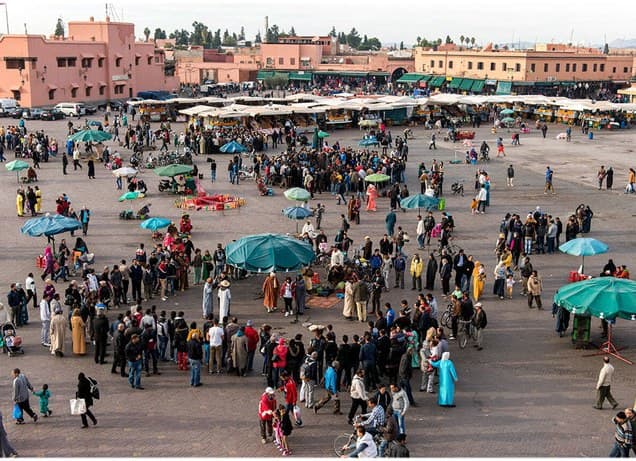
If you stand still in the Jemaa el-Fna in the evening, you will sooner or later find yourself on the edge of a circle of people listening to one person talk. That circle is a halqa — the word means "ring" in Arabic — and the person at its centre is carrying on one of Morocco's oldest living art forms.
What it is
A halqa is a performance held in the round, in a public square, with no stage and no ticket. The storyteller works with voice, gesture and timing, sometimes with a musician alongside on a gimbri, and leans on the crowd — its laughter, its heckles, its questions — to shape the tale. The stories mix history, myth, religion, humour and a moral, and no two tellings are quite the same.
Where it comes from
The tradition draws on three threads: Berber folklore, with its spirits and heroes; Arabic poetry and proverbs; and the Andalusian styles brought by families who left Spain after 1492. Before books were common, travelling storytellers carried news and history from town to town this way.
Why it mattered
The halqa was entertainment, but it was also a school and a newspaper. It taught children right from wrong, kept genealogies and events in circulation, and drew people of every class into the same circle for an hour.
Where to find it now
- Jemaa el-Fna, Marrakech — the heart of it, and recognised by UNESCO as a cultural space. Performances run daily, mostly from late afternoon into the evening.
- Fes, Meknes and Essaouira — smaller circles, often around festival time.
Numbers have thinned as screens have taken the audience, but cultural groups and universities are now recording the old tellers and teaching younger ones.
If you stop to watch
Join the circle rather than hover outside it, ask before photographing the teller, and stay a while rather than passing through — then leave a few coins when the hat comes round. You will not follow every word, but the shape of it comes across.
This article touches on 2 UNESCO World Heritage Sites: Medina of Marrakesh, Medina of Essaouira.
See it in person on a day trip
Planning a trip to Morocco?
Every trip we run is private and built around you. See our journeys and day trips, or tell us what you have in mind.
More from the journal
All articles Culture
· Khalid
Why Moroccan Couscous Is More Than Just a Dish
Couscous traces back to Berber communities at least a thousand years ago, and was recognised by UNESCO in 2020 — here's the history behind Friday's family meal.
Read more → City guide
· Khalid
How to Walk Marrakech Like a Local
Beyond the Jemaa el-Fna — the specialist souks, the quieter neighbourhoods, and the everyday etiquette that makes exploring Marrakech on foot go smoothly.
Read more → Culture
· Khalid
The Rose Valley of M'Gouna: Morocco's Valley of Roses
Once a year, the valley around Kelaa M'Gouna fills with Damask roses — hand-picked at dawn, distilled into rose water, and celebrated with a real local festival.
Read more →